
Do California Home Improvement Contracts Need Approximate Start and Completion Dates?
California home improvement contracts generally must include an approximate start date, an approximate completion date, and a definition of substantial commencement under Business and Professions Code §7159. This article explains what contractors should include, what "approximate" means in practice, and how to handle uncertain timelines at signing.
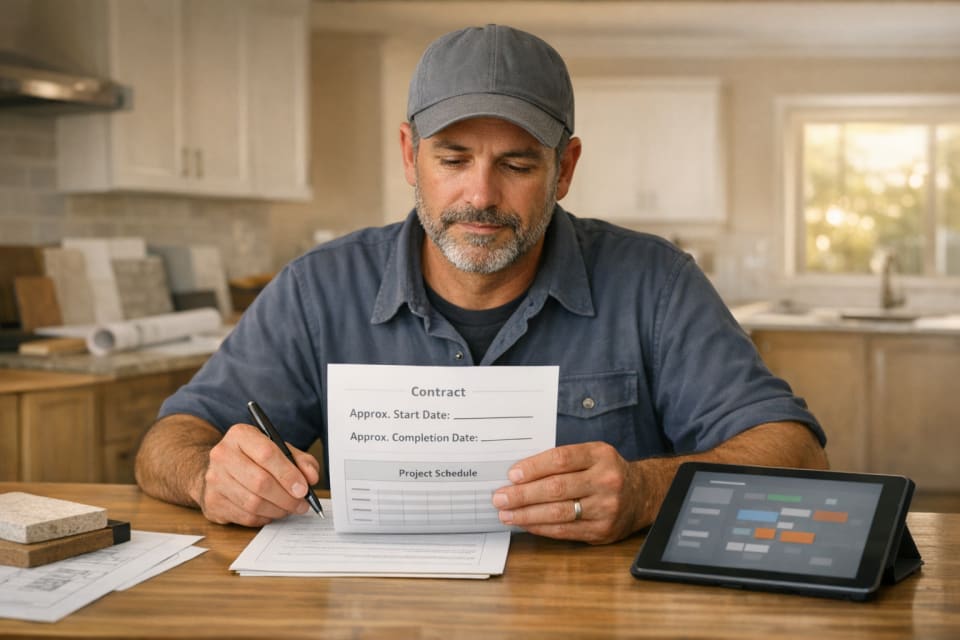
Yes. Under California Business and Professions Code §7159, every home improvement contract must state an approximate start date and an approximate completion date. The law also calls for a description of what substantial commencement of work means under the agreement. None of these are discretionary. When a contract covers residential home improvement work with a total value above $500, the timing provisions are among the elements the statute expects to find in the written document.
This article explains what those requirements mean in practical terms, what a compliant date section looks like, what happens when dates are missing, and how to handle the common situation where a contractor genuinely does not know the exact timeline at signing. Everything here is general educational information for California residential contractors — not legal advice. Statutes change, and contractors should verify current requirements through the Contractors State License Board (CSLB) or an attorney.
What California Law Requires for Timing in Home Improvement Contracts
Section 7159 of the California Business and Professions Code governs written contracts for home improvement work performed on residential property. That section contains three distinct timing-related obligations that must appear in every covered contract.
1. A Description of Substantial Commencement
The contract must describe what will constitute substantial commencement of work for that specific agreement. In practical terms, this means identifying the moment when meaningful physical work actually gets underway on the homeowner's property — not simply ordering materials, obtaining a permit, or putting a crew on the schedule, but visibly beginning the project in a way the homeowner can observe and verify.
On a kitchen remodel, substantial commencement might be defined as the start of demolition on the existing cabinetry. On a roofing project, it might be the removal of the first portion of old roofing. The description should be concrete enough that both parties have a clear, shared understanding of what it means for work to have genuinely gotten underway.
This is the timing element that contractors most often omit entirely or address with language too vague to be useful. Writing a clear definition into the contract benefits both the contractor and the homeowner by establishing a mutual reference point.
2. The Approximate Start Date
The contract must carry a heading labeled "Approximate Start Date" together with the actual date. This tells the homeowner roughly when work is expected to begin. The statute uses the word approximate, which provides some flexibility — but that flexibility does not permit a blank field, a notation like "TBD," or language that simply defers the date to a later decision.
3. The Approximate Completion Date
The contract must also carry a heading labeled "Approximate Completion Date" together with the actual date. The same principle applies: the homeowner should be able to read the signed contract and find a reasonable target for when the project is expected to wrap up.
What "Approximate" Actually Means for Contractors
The word approximate in the statute gives contractors space to provide a realistic estimate rather than a firm, unconditional guarantee. It reflects the reality that residential construction involves variables — permit timelines, material lead times, weather, subcontractor availability, homeowner decisions, and inspection schedules — that make pinning down exact dates at the time of signing genuinely difficult.
But approximate does not mean the field is optional. It does not mean the date can be skipped. It does not mean a contractor can substitute a conditional phrase in place of an actual date. What it means is that the contractor provides the most reasonable estimate available at signing, with the understanding that real-world conditions may cause the timeline to shift.
Here is what a compliant date section might look like in practice:
Approximate Start Date: March 15, 2025
Approximate Completion Date: May 30, 2025
Substantial Commencement: Substantial commencement of work shall mean the beginning of demolition of existing flooring and removal of base cabinets from the kitchen area.
Compare that with a noncompliant version:
Start: TBD
End: TBD
Commencement: When work begins.
The first version gives the homeowner a real expectation. The second version gives nobody anything. Even if the first version's dates shift by a few weeks, the contractor started with a clear, good-faith estimate — and that is what the statute is after.
What Happens If These Dates Are Missing from the Contract
A home improvement contract that omits required elements under §7159 can create several problems.
- CSLB disciplinary exposure. The Contractors State License Board can take disciplinary action against a licensed contractor whose contracts do not comply with the statutory requirements. This can include citations, fines, or impacts on the contractor's license status.
- Contract compliance issues. A contract that is missing required provisions may be subject to challenge. In a dispute, missing date fields can become evidence that the contract was not properly assembled.
- Homeowner protection concerns. California's home improvement contract requirements exist in part to protect homeowners. A homeowner who discovers that their contract is missing required fields — or who consults with an attorney during a dispute — may have additional remedies or leverage.
None of this means that a single missing date automatically results in license revocation or a lost lawsuit. The consequences depend on the circumstances, the severity, and whether the contractor has a pattern of noncompliance. But the risk is real, and it is avoidable.
An Important Distinction: Including the Dates vs. Being Liable for Missing Them
This is a point that most explanations of §7159 skip entirely, and it matters.
The obligation to include approximate start and completion dates is a compliance requirement. When those dates are absent, the contract falls short of the statutory standard. That is an entirely separate question from whether a contractor is liable for delay when a project extends past the approximate completion date.
Delay liability turns on what the contract says about delays, what actually caused the schedule to move, whether the contractor communicated the change in a timely way, and whether a change order was executed. An approximate completion date of June 15 does not automatically place the contractor in breach on June 16. The outcome depends on the contract language, the facts, and the documentation.
The takeaway for contractors: include the dates because the statute requires them, but understand that an approximate date is not the same as an absolute deadline. Your contract language around delays, change orders, and timeline adjustments matters as much as the date itself.
Which Contracts Are Subject to This Requirement
The §7159 timing requirements apply to written contracts for home improvement work on residential property when the contract amount exceeds $500, including labor and materials.
That covers a wide range of work:
- Kitchen and bathroom remodels
- Room additions and ADUs
- Roofing
- Flooring
- Exterior painting
- Window and door replacement
- Solar installations on existing residential structures
- Restoration and reconstruction on residential properties
- Most other residential remodeling and improvement work
The definition of residential property under the statute includes single-family homes, apartment buildings, condominiums, and mobile homes when the work qualifies as home improvement. Work for tenants on residential property can also fall under these requirements depending on the circumstances.
Which Contracts Are Exempt or Use Different Rules
Not every residential contract falls under §7159. Two important distinctions:
Service and Repair Contracts (§7159.10)
California has a separate statute — Business and Professions Code §7159.10 — that governs service and repair contracts. These cover smaller-scope work such as fixing a leaking faucet, repairing a water heater, or addressing a specific maintenance issue. Service and repair contracts have their own set of requirements, which overlap with §7159 in some areas but differ in others. If a contractor's work falls under §7159.10 rather than §7159, the specific timing requirements may differ. Contractors doing this type of work should review §7159.10 separately.
New Residential Construction
Contracts for new residential construction — building a new home from the ground up — are generally not governed by §7159. The home improvement statute applies to improvements on existing residential property. New construction contracts have their own requirements and conventions.
Projects Under $500
The written-contract requirements under §7159 apply to contracts exceeding $500 in total, including labor and materials. Projects under that threshold are not subject to the same statutory contract requirements, though putting any agreement in writing is still good practice regardless of the dollar amount.
What to Do When the Timeline Is Genuinely Uncertain at Signing
This is the real-world question behind the search. A homeowner just said yes to a bathroom remodel. The contractor needs to get the contract signed while the momentum is there. But the permit has not been pulled yet, the tile has a six-week lead time, and the plumber's schedule is unpredictable. What goes in the date fields?
The answer is not to leave them blank. It is to provide your best honest estimate based on what you know at the time.
Practical guidance:
- Use a realistic range-based approach. If you expect the permit process to take three to four weeks and you need another week to mobilize, an approximate start date that is five weeks from signing is a reasonable estimate. You do not need it to be perfect. You need it to be a genuine good-faith estimate.
- Account for known delays in your estimate. If you know the materials take eight weeks and the work takes four weeks after that, your approximate completion date should reflect the full timeline — not just the construction phase.
- Describe substantial commencement in concrete, observable terms. Identifying the first visible task — such as tearing out the master bathroom floor — gives both parties a clear marker. Vague language like "starting work" does not.
- Document changes when they happen. If the timeline shifts after signing — because the permit took longer, the homeowner changed the tile selection, or a subcontractor rescheduled — document the change through a written change order or amendment. Do not just let the dates drift without a paper trail.
The statute does not penalize contractors for honest estimates that shift due to real-world conditions. It penalizes the absence of any estimate at all.
How Date Provisions Connect to the Rest of the Contract
Start and completion dates do not live in isolation. They connect to other parts of the contract package in ways that matter operationally.
- Payment schedule. If the payment structure is tied to project phases or milestones, those milestones should align logically with the timeline established by the start and completion dates. A payment schedule that calls for a final payment at substantial completion only makes sense if the contract has defined when completion is expected.
- Scope of work. The scope defines what work is being done. The dates define roughly when it will happen. If the scope changes through a change order, the dates may need to change too — and that change should be documented.
- Change orders. When the scope, cost, or timeline changes after the contract is signed, a written change order captures the modification. If a change order affects the timeline, the updated approximate dates should be reflected in the documentation.
- Cancellation rights. California homeowners generally have the right to cancel a home improvement contract within three business days. The timeline provisions and the cancellation notice are both part of the broader set of contract requirements that need to be handled together.
When these elements are drafted separately — dates in one document, scope in another, payment in a third — inconsistencies and gaps are almost inevitable. That is one of the reasons a connected contract workflow matters.
Where ContractBuilderAI Fits
ContractBuilderAI is a guided contract workflow built for California residential home improvement contractors. It is not a law firm, does not provide legal advice, and does not guarantee legal compliance.
What it does is walk contractors through the contract assembly process — homeowner intake, scope drafting, materials and specifications, payment structure, required notices, electronic signatures, delivery, and records — in one connected workflow. The timing provisions covered in this article are part of that workflow, so contractors do not have to remember on their own which fields the statute requires or whether they accidentally left a date blank.
If you are currently using a template your attorney created, that may be working well for your business. ContractBuilderAI is not here to replace your attorney's judgment. It is here to reduce the repetitive assembly work — the copying, reformatting, chasing signatures, and late-night paperwork — that happens every time you turn a won job into a signed contract.
Contractors remain responsible for the information they enter, their licensing obligations, and reviewing the final contract. Attorney review is always appropriate when questions arise about specific projects or legal requirements.
Frequently Asked Questions
Can I leave the start or completion date blank and fill it in later?
No. The statute requires these dates to be part of the written contract at the time it is signed. A blank field does not satisfy the requirement. Use your best reasonable estimate and document any changes through a written change order if the timeline shifts later.
Does "approximate" mean I can write any date?
It means you can provide a good-faith estimate rather than an exact guarantee. It does not mean you can put a placeholder date you know is unrealistic. The date should reflect your honest expectation based on what you know at signing.
What is "substantial commencement" and why does the contract need to define it?
Substantial commencement is the point at which meaningful physical work begins on the homeowner's property. The statute requires the contract to describe what this means for the specific project — for example, beginning demolition, starting excavation, or removing existing fixtures. This gives both parties a shared understanding of when the project has genuinely started.
If I miss the approximate completion date, am I automatically in breach of contract?
Not automatically. An approximate completion date is an estimate, not a hard deadline. Whether a delay creates a breach depends on the contract language, the cause and length of the delay, whether the contractor communicated the change, and whether a change order was issued. The distinction between the compliance obligation to include the date and the question of delay liability is important. Contractors with questions about specific delay situations should consult an attorney.
Does this requirement apply to small repair jobs?
It depends. If the work falls under California's service and repair contract statute (§7159.10) rather than the home improvement contract statute (§7159), different requirements may apply. If the total contract amount is $500 or less, the written-contract requirements under §7159 generally do not apply. Contractors should review the applicable statute for the type of work they are performing.
Can I change the dates after the contract is signed?
Yes, but the change should be documented in writing — typically through a change order or written amendment that both the contractor and homeowner acknowledge. Do not simply let the dates drift without any documentation. A clean paper trail protects both parties.
What official source should contractors check for current requirements?
The Contractors State License Board (CSLB) is the primary regulatory authority for licensed contractors in California. The full text of Business and Professions Code §7159 is available through the California Legislative Information website. Because statutory requirements can change, contractors should verify current requirements periodically and consult an attorney when needed.
The Bottom Line
California law requires home improvement contracts to include an approximate start date, an approximate completion date, and a description of what constitutes substantial commencement. These are not suggestions and not optional fields. The word approximate gives contractors reasonable flexibility — not permission to leave the fields blank.
For contractors who assemble contracts regularly, the question is not whether these fields are required. It is whether the current process makes it easy to get them right every time, across every estimator or salesperson, on every job. That is a workflow problem, and it is exactly the kind of problem ContractBuilderAI was built to help solve.
Request California Early Access to see how a guided contract workflow handles timing provisions, scope drafting, payment structure, required notices, signatures, and records — in one connected process.