
Can AI Draft a Residential Scope of Work From Real Job Information? Yes, With a Review Step
AI can organize walkthrough notes, measurements and estimate line items into a first-draft residential scope of work. A hypothetical hall-bath example shows what the contractor still needs to fix, verify and decide before sharing it with a homeowner.
Can AI Draft a Residential Scope of Work From Real Job Information? Yes, With a Review Step
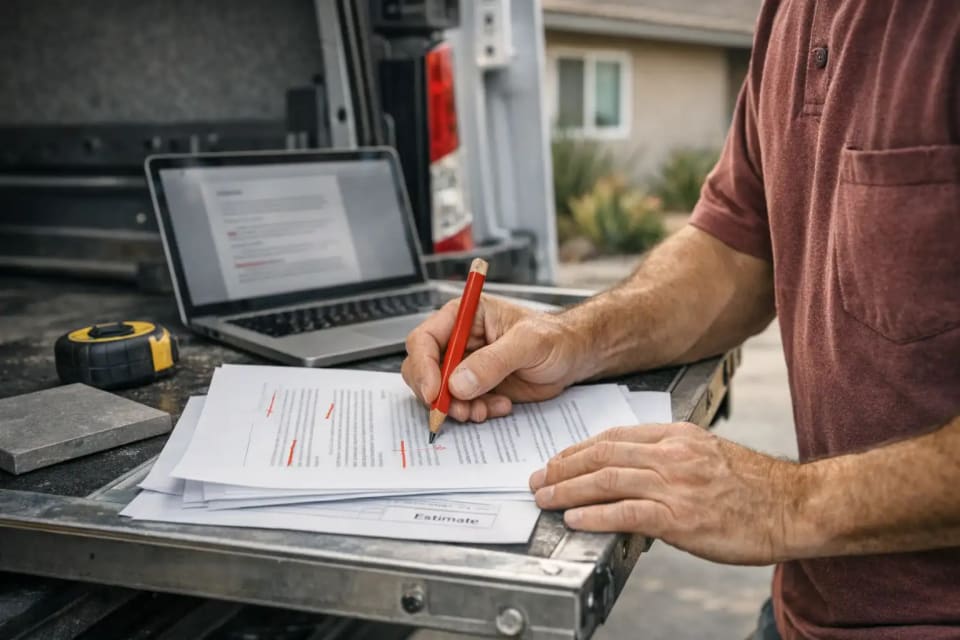
Yes. AI can turn real job information such as walkthrough notes, your measurements, homeowner requests and estimate line items into a usable first-draft scope of work. It works best for licensed residential remodelers who already have specific job details and want them organized into inclusions, exclusions, assumptions, allowances and open questions. What it cannot do is see behind the wall, confirm what you promised verbally, or decide what the scope should be. This article shows what to feed it, what it gets wrong, a hypothetical hall-bath example with the contractor's markup, and a six-stage workflow with a human checkpoint at each step.
What a scope of work is, and why the wording matters
A scope of work is the section of a home improvement contract that describes what will be done, with what, by whom, and what is not included. On a residential remodel it usually runs by trade or phase: demolition, plumbing, electrical, tile, fixtures, paint, cleanup.
The quality bar is simple to state and hard to hit: a homeowner, a sub and you should each read the scope and describe the same finished bathroom. The Contractors State License Board (CSLB) consumer guidance on home improvement contracts says a contract should describe in detail the products to be used and how the work will be performed, with examples like size, color, who does what work, amounts of materials and manufacturer model number. The same guidance says a written contract helps avoid misunderstandings about what a job will include. (CSLB, "What Is a Contract?"; publication date not stated, so treat it as guidance on specificity rather than a statement of current law.)
That specificity bar is the standard an AI draft has to be reviewed against. Generic chatbot output tends to fill gaps with phrases like "as required," "per code" and "standard finishes." Those phrases are exactly what scope disputes are made of.
What counts as "real job information"
Real job information is anything specific to this job that you can hand over as text or a clear description. The more of it you give, the less the draft has to guess.
- Walkthrough notes or a voice transcript, including the homeowner's requests as they were actually said.
- Your own measurements, not approximations from memory where you can avoid it.
- Selections already made: tile, fixtures, paint, with model numbers where known.
- Estimate line items and sub quotes, so the scope matches what you priced.
- Plan notes and schedules, if drawings exist. Plan text is useful; measurements from drawings are a separate problem (more below).
- Photos with your captions. A photo of a soft tub surround tells the AI nothing unless you write "surround soft near drain, possible water damage behind."
- Permit notes and anything you already know about the local building department's expectations.
- Past scopes for similar jobs, if you want consistent formatting and phrasing.
Photos without dimensions, product data and confirmed conditions give the AI little to work from. Notes with measurements and selections give it a lot.
What to leave out
Leave out what the draft does not need: the homeowner's full name, phone number and exact street address. The draft reads the same with "Jenkins hall bath" replaced by "Job 2411, hall bath." You can add names back when the scope moves into the contract.
Data handling differs by AI product and plan. OpenAI, for example, states that by default it does not use business data (ChatGPT Business, Enterprise and the API) for training, while consumer plans handle data differently depending on the user's settings (OpenAI enterprise privacy; OpenAI help center data privacy FAQ). Those terms change, and other vendors have their own. Read the current terms for the specific tool and plan you use before pasting project details into it. This article does not call any tool safe or unsafe.
What AI does well on a scope draft
- Structuring. It sorts a stream of notes into phase sections in a consistent order.
- Rewriting shorthand. "Pull tub, surround, van, toilet, flr" becomes four plain sentences.
- Proposing exclusions and assumptions. It will usually suggest things like "existing drain line assumed serviceable" that you then confirm or strike.
- Flagging gaps. If told to, it lists what the notes do not answer instead of inventing an answer.
- Consistency. The fourth bathroom scope this month reads like the first one.
Note what is missing from that list: judgment about what the job actually needs, and any guarantee that a number or product name in the draft is correct.
What AI cannot know about a remodel
AI reads the words on your paperwork. It cannot see behind the wall. Before a draft goes anywhere, you are the only one who can confirm:
- Hidden conditions. Soft subfloor, old wiring, suspected hazardous materials, a drain line that is not where the notes assume.
- Quantities taken from drawings. Foreman AI, a takeoff software vendor, explains in a 2026 post that general chatbots read the text on plans well (notes, schedules, title blocks, callouts) but are much weaker at measuring to scale, counting dense symbols and staying consistent across a plan set, and that a wrong count looks exactly like a right one (Foreman AI). That is one vendor's explanation, not a benchmark, but it matches the practical rule: treat any quantity in a draft as unverified until you check it against your estimate.
- Local permit realities. Whether this city wants a plumbing permit, an electrical permit, or both for a bath.
- What was promised verbally. CSLB consumer guidance says that if something is promised verbally, it should be included in writing. The AI can only put it in writing if your notes contain it. If you told the homeowner on the porch that you would haul the debris, that promise lives in your head until you write it down.
- What your crew actually does. A draft that assumes you do final cleaning, or that you do not, is a coin flip unless you said so.
A hypothetical example: raw notes, AI draft, contractor markup
This example is hypothetical and written for illustration. It is not a real job, and it is not the recorded output of any specific tool or model. The "AI draft" is written to show the kind of weaknesses a first draft typically contains and how a review pass catches them.
1. The raw walkthrough notes
Hall bath, 2nd floor, job 2411. Approx 5x8. Pull tub, surround, vanity, toilet, floor.
Tub surround looks soft near the drain, maybe water got behind it.
Keep tub location. New 60 in alcove tub, tile surround to ceiling.
She wants the niche bigger, two shelves.
Vanity 36 in, she's picking at the showroom Thursday.
Toilet she already bought, it's in the garage.
Floor tile 12x24 porcelain, we supply, she picked the gray one.
Exhaust fan is old, swap it.
Lights, maybe move the vanity light over a bit, see what's in the wall.
Paint walls and ceiling.
Told them we'd haul debris.
Permit, city, check if just plumbing or also electrical.
Dave doing plumbing.
Estimate lines: demo, plumbing rough and trim, tile labor 110 sf surround + 40 sf floor,
vanity install, fan swap, paint.
2. The AI first draft
Inclusions
- Demolition: Remove existing tub, tub surround, vanity, toilet and floor finish. Repair subfloor as needed.
- Plumbing: Rough-in and trim for new 60-inch Kohler alcove tub in existing location. Reconnect toilet and vanity supply and drain.
- Tile: Install tile surround to ceiling, approximately 110 sq ft, with enlarged two-shelf niche. Install 12x24 porcelain floor tile, approximately 40 sq ft. Standard white grout.
- Fixtures: Install 36-inch vanity. Install homeowner-supplied toilet.
- Electrical: Replace exhaust fan. Relocate vanity light as required.
- Paint: Paint walls and ceiling.
- Cleanup: Remove debris.
Exclusions
- Work outside the hall bathroom.
- Structural changes.
Assumptions
- Existing drain and vent are serviceable.
- Permit obtained by contractor.
Allowances
- Vanity: to be selected.
Open questions
- Extent of water damage behind surround.
- Permit type required.
That is a reasonable draft. It is also not ready to send. Read it as a contractor and the problems show up fast.
3. The contractor's review markup
Fix (wording to make specific)
- "Kohler" is invented. The notes say "60 in alcove tub," not a brand. Replace with the actual model once selected, or list the tub as an allowance with a dollar amount.
- "Repair subfloor as needed" puts an unknown cost inside the base price. Change to: subfloor repair is not included in the contract price; if damage is found at demolition, it will be priced by written change order before that work begins.
- "Relocate vanity light as required" defines nothing. Change to: relocate the existing vanity light junction box up to 12 inches along the same wall, using the existing circuit; relocation beyond that, or a new circuit, requires a written change order.
- "Standard white grout" is not a selection. Change to the grout brand and color after the homeowner picks it, or state that grout color is selected by the homeowner before tile starts from the contractor's sample set.
- "Remove debris" is close, but the verbal promise should be unambiguous: contractor hauls all demolition debris and job waste off site. Then decide whether final cleaning of the room is included and say so.
- "Approximately 5x8" and the square-foot figures came straight from the estimate line items. They stay, but only after the measurements are confirmed on site.
Verify (needs a site check, a sub, a supplier, a permit office or a professional)
- The soft spot near the tub drain. Nobody knows what is behind it until demo. Keep it as an open question in the scope and tie it to the change-order sentence above.
- Permit type. Call the city before the scope is finalized, so the assumption "permit obtained by contractor" names which permits.
- What is in the wall where the light would move. Electrician looks before the 12-inch limit is promised.
- Whether Dave's plumbing quote covers a new tub valve and drain or assumes reuse. The draft said "existing drain and vent are serviceable"; the plumber should confirm that assumption or strike it.
- Whether the stud bay allows a larger two-shelf niche at the size the homeowner has in mind. Confirm dimensions before writing them in.
Decide (allowance versus fixed selection, and what triggers a change order)
- Vanity. If she picks Thursday and the contract is signed after that, write the model number and treat it as a fixed selection. If the contract is signed first, carry it as an allowance with a stated dollar amount and a stated process for the difference.
- Floor tile. Already selected and contractor-supplied. Write the product, color and quantity. This is a fixed selection, not an allowance.
- Homeowner-supplied toilet. Contractor installs it; contractor does not warranty the fixture; if it arrives damaged or defective, replacement and any reinstallation are a change order.
- Paint. Two coats on walls and ceiling, color selected by the homeowner before the paint stage. Trim and door are either in or out; the notes did not say, so decide and write it.
- Change-order triggers. Any of: subfloor repair, light relocation beyond 12 inches, plumbing beyond reconnection at the existing locations, a selection that exceeds its allowance.
Notice the pattern. The AI did the organizing. The contractor did the deciding. The reviewed scope is shorter on adjectives and longer on limits, and the open questions are written into it rather than hidden in someone's memory.
Vague-to-specific: a wording table for residential scopes
These replacement patterns are drafting practice, informed by the CSLB consumer guidance on describing products and how work will be performed. They are not statutory language, and they are not a contract form.
| Vague phrase in the draft | Tighter replacement pattern | Question the contractor must answer first |
|---|---|---|
| "as required" / "as needed" | "Install [item] at [location]. Work beyond [defined limit] requires a written change order." | What is the limit of what the base price covers? |
| "per code" / "to code" | "Work performed under [permit type] issued by [jurisdiction]; required inspections included." | Which permits and inspections does this jurisdiction actually require for this job? |
| "standard finishes" | "[Product], [color], [model number]; see materials list." | Has the homeowner selected it, and is it fixed or an allowance? |
| "remove debris" | "Contractor hauls demolition debris and job waste off site. Final cleaning of the room [is / is not] included." | Who cleans, how often, and is a dumpster or a trailer part of the price? |
| "paint as needed" | "Prime and paint walls and ceiling, two coats, [brand/sheen], color selected by homeowner before paint stage. Trim and door [included / excluded]." | Does the price include patching, trim, doors, or a primer coat over new drywall? |
| "repair subfloor as needed" | "Subfloor repair not included in contract price. If found at demolition, priced by written change order before work proceeds." | Do you want to quote a unit rate now or price it when it is found? |
| "install homeowner-supplied [fixture]" | "Contractor installs homeowner-supplied [fixture]. Contractor does not warranty the fixture. Replacement of a defective or damaged fixture is a change order." | Who is responsible if it is the wrong rough-in size or arrives broken? |
A six-stage workflow with a human checkpoint at each stage
-
Gather and clean the inputs. Notes, measurements, selections, estimate line items, sub quotes, permit notes.
Checkpoint: the person who walked the job confirms the notes reflect what was seen and what was said. -
Strip personal data the draft does not need. Replace the homeowner's name and address with a job number.
Checkpoint: whoever pastes the inputs confirms no name, phone number or street address is going in, and has read the current terms for the tool and plan in use. -
Prompt with constraints. Tell the AI what not to do. A workable prompt reads something like:
You are helping a licensed residential remodeling contractor draft a scope of work. Use only the notes and estimate line items below. Organize by phase: demolition, plumbing, electrical, tile, fixtures, paint, cleanup. Write inclusions, exclusions, assumptions, allowances and open questions as separate lists. Do not invent dimensions, brands, model numbers, quantities or prices that are not in the notes. If something is unclear or missing, list it under open questions instead of guessing. Do not use "as required," "as needed," "per code" or "standard" unless the notes define what they mean.
Checkpoint: the estimator confirms the prompt includes the no-invention rule and the open-questions rule before running it. -
Review the draft against three things: the site, the estimate, and what was promised. Use the Fix / Verify / Decide lists from the example above.
Checkpoint: the estimator or project manager signs off that every number and product name matches the estimate and measurements, and every vague phrase has been replaced. - Resolve open questions and allow